
Hashtags
Shared-Interest Discovery Across People and Rooms
Principal Product Designer
Sole Designer
0→1 Feature
PM: 1
Eng: 8
Partners: Data, QA, Marketing
Android
iOS
Desktop
Jan–Dec 2024
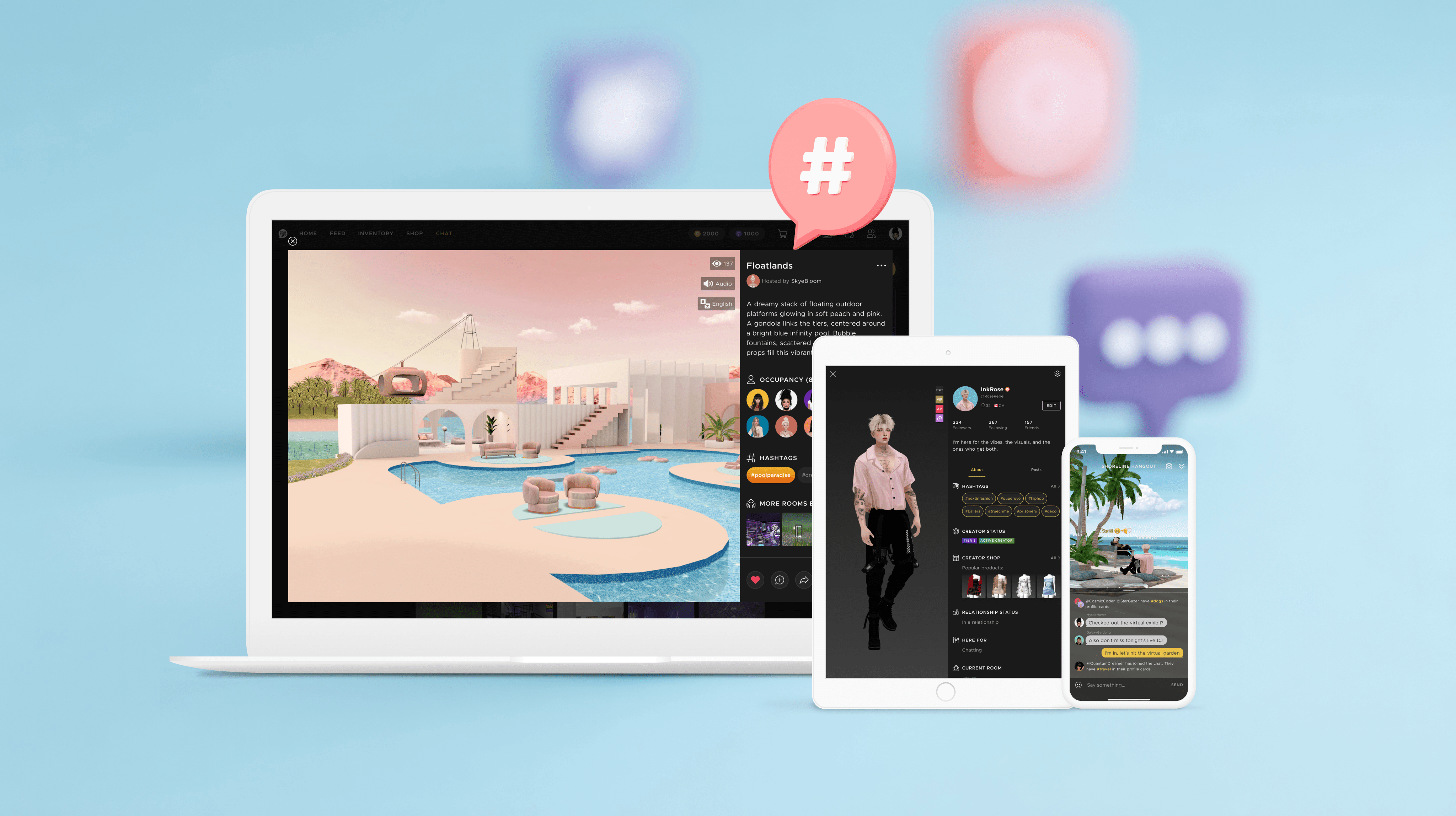
Overview
IMVU is a social 3D platform powered by relationships and a massive UGC economy. But as people, rooms, and content scaled, discovery broke down—new users didn’t know where to start, and returning users kept seeing the same stale recommendations. Engagement flattened, and retention suffered.
To fix this, I was the principal (and sole) designer for a new social discovery layer: Hashtags, a shared-interest system that helps users quickly find people like me and rooms I’ll enjoy. I owned end-to-end UX + UI across platforms and shipped it in two phases:
Help users express interestes in a structured way and quickly spot shared interests with others.
Extend the same interest graph into rooms, so users can find conversations and experiences they like.
The Social Gaps We Found
Users kept telling us the same thing in surveys and interviews: “I just want to meet people who like what I like.”
The issue wasn’t that we lacked content, features, or people—it was discoverability:
Two user surveys crystallized this gap:
- Friend Matcher survey (SurveyMonkey):
Top challenge to finding a compatible match — “finding someone with similar interests as me."
- Room survey (SurveyMonkey):
Most helpful feature to find a chat/live room — “searching by interests of people in the room.”

Friend Matcher Survey Snapshot - Survey Monkey
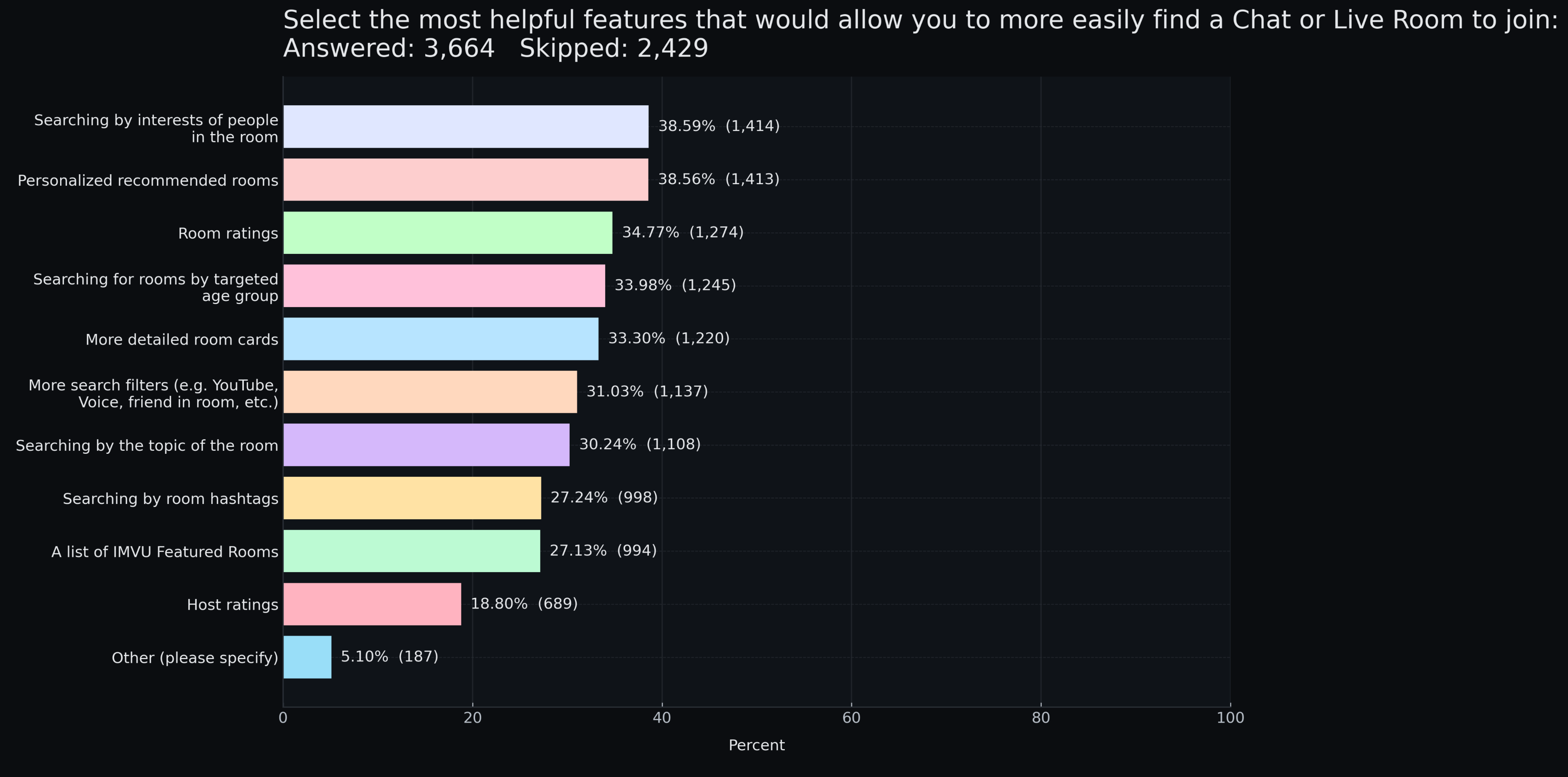
IMVU Room Survey Snapshot - Survey Monkey
The Old Solution: and Why It Didn't Scale
Before hashtags, users tried to express interests through Bio and Interests sections using plain text. Limitations are:
Not discoverable: Interests are plain text, so they’re not clickable or reliably searchable, making it hard to find people/rooms with the same interests.
Not standardized: Users describe the same interest in many ways (synonyms, hashtags, typos, emojis), which fragments matching and reduces consistency.
Poor Scanability: Because interests aren’t structured data, it’s difficult to power shared-interest signals, recommendations, or accurate ranking.
Moderation & Spam Risk: Freeform fields are easier to abuse (spam/promos/inappropriate text), increasing safety and enforcement overhead.
Localization Fragmentation: Interests written in different languages/scripts don’t map cleanly, so discovery and matching break across regions.
Hard to Measure & Iterate: Analytics become messy when everything is freeform text, making it tough to track adoption, compare variants, or improve outcomes.
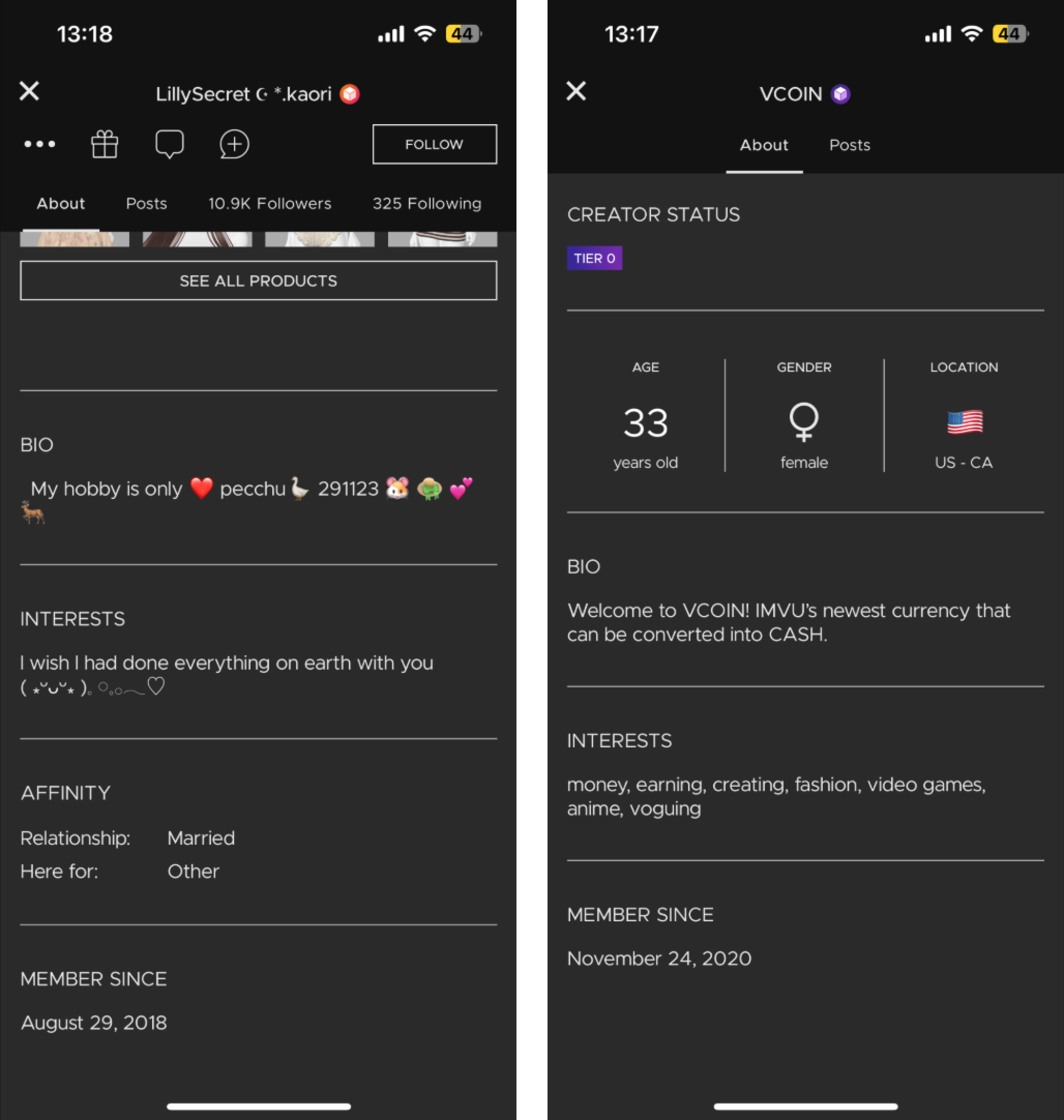
Design Challenge
How might we create a shared, scalable "Interest Language" that becomes the connective tissue across IMVU?
The New Solution:
Hashtags as the Foundation of Interest-Led Discovery
We introduced hashtags as a structured interest layer—a shared language that makes interests visible, standardized, and searchable across the ecosystem.
1
People Hashtags
Users add interests in a standardized hashtag system, making shared interests immediately visible in social surfaces and powering better people discovery.
2
Room Hashtags
Room discovery is driven by the interests of participants—so users can find live conversations through what they care about, not just what’s featured.
Phase 1: People Hashtags
Phase 1 is People Hashtags—helping users express their interests in a structured system. Each hashtag doubles as a discovery shortcut: tap it to find people who share that interest, instantly see what you have in common, and add or follow them right from the results.

Hashtag Access & incentivized onboarding
I introduced hashtags through a welcome quest for new users—framing them as the fastest way to “find people like me,” and using rewards to drive first-time adoption and reduce cold-start friction for social discovery.
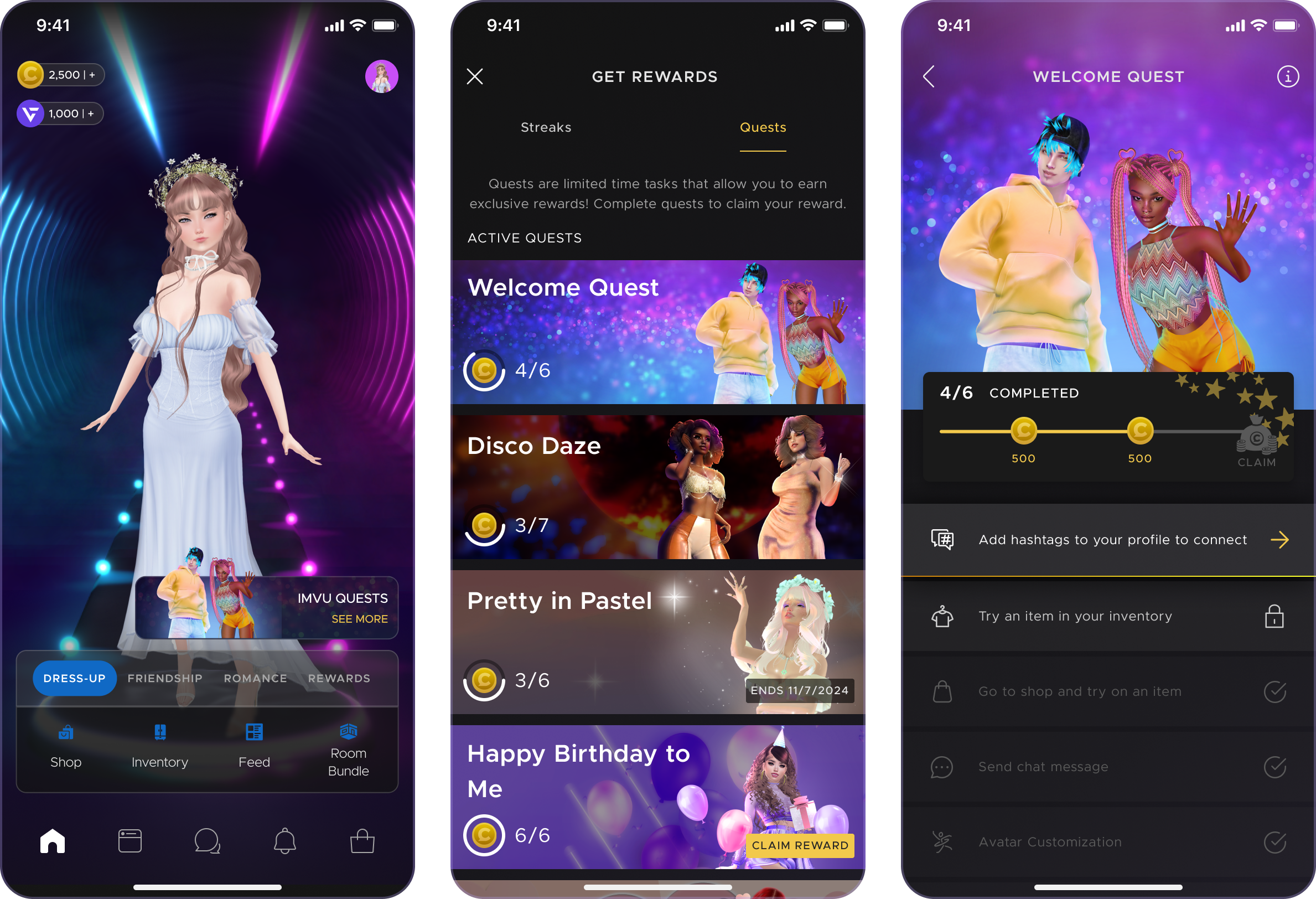
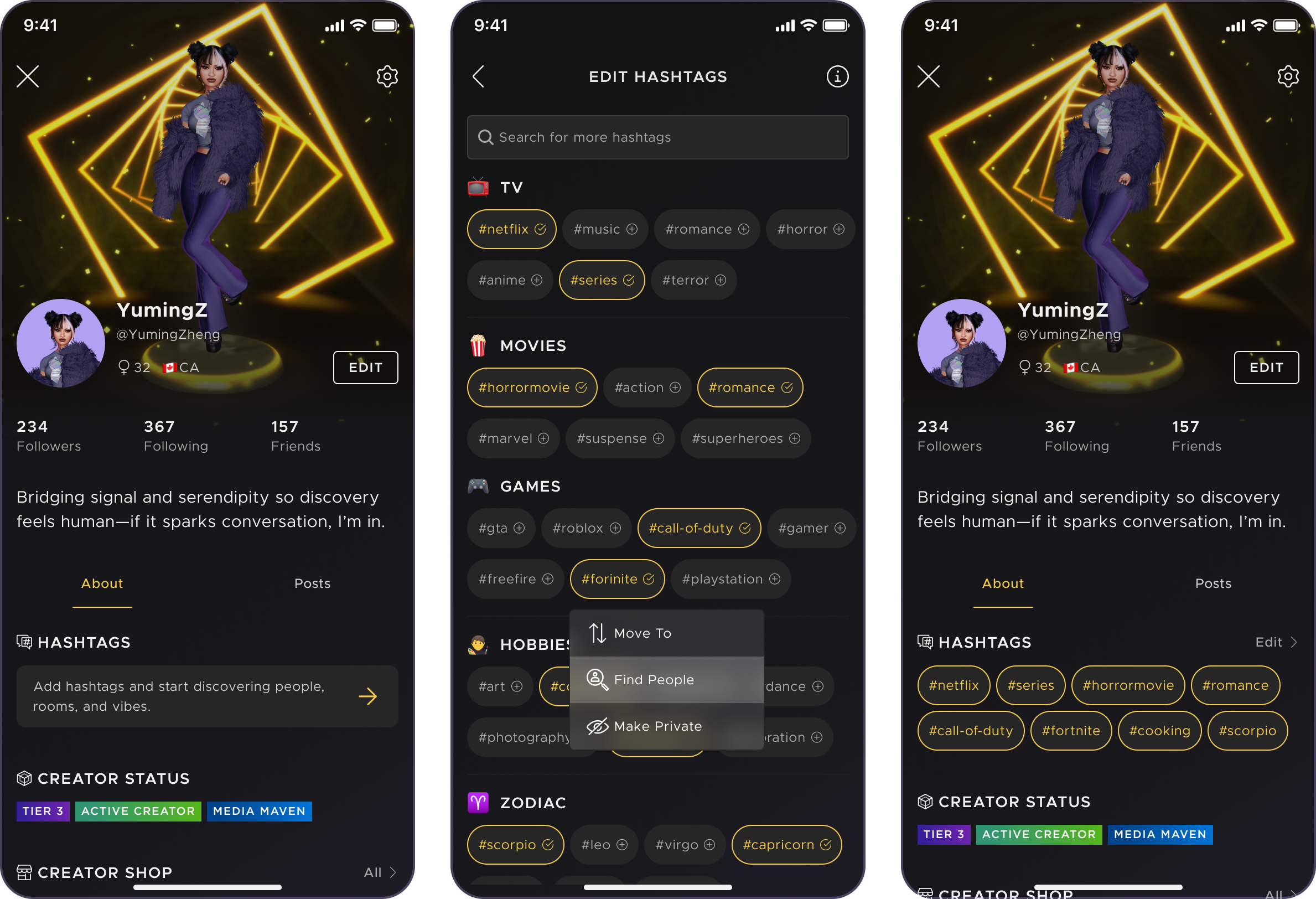
Add & Manage Hashtags
I added a dedicated hashtag section on the profile card with curated categories and one-tap add/remove, plus quick actions (find people, recategorize, set private) so users can express identity with minimal effort and control.
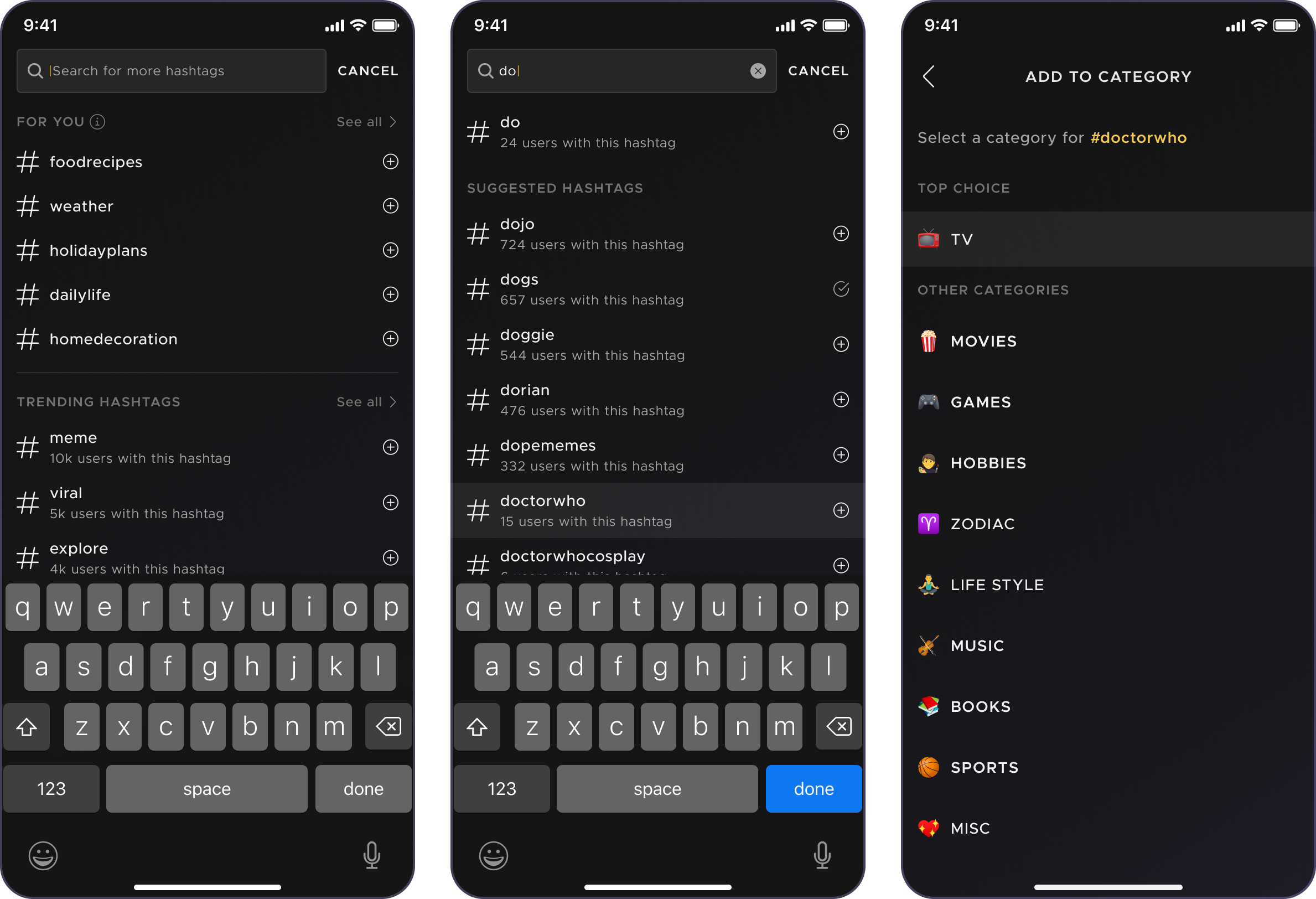
Smart Search & Creation
I built a guided search experience with personalized “For You” suggestions (based on rooms you chat in), trending hashtags, real-time autocomplete with user counts, and support for creating new tags—so the system stays scalable and inclusive.
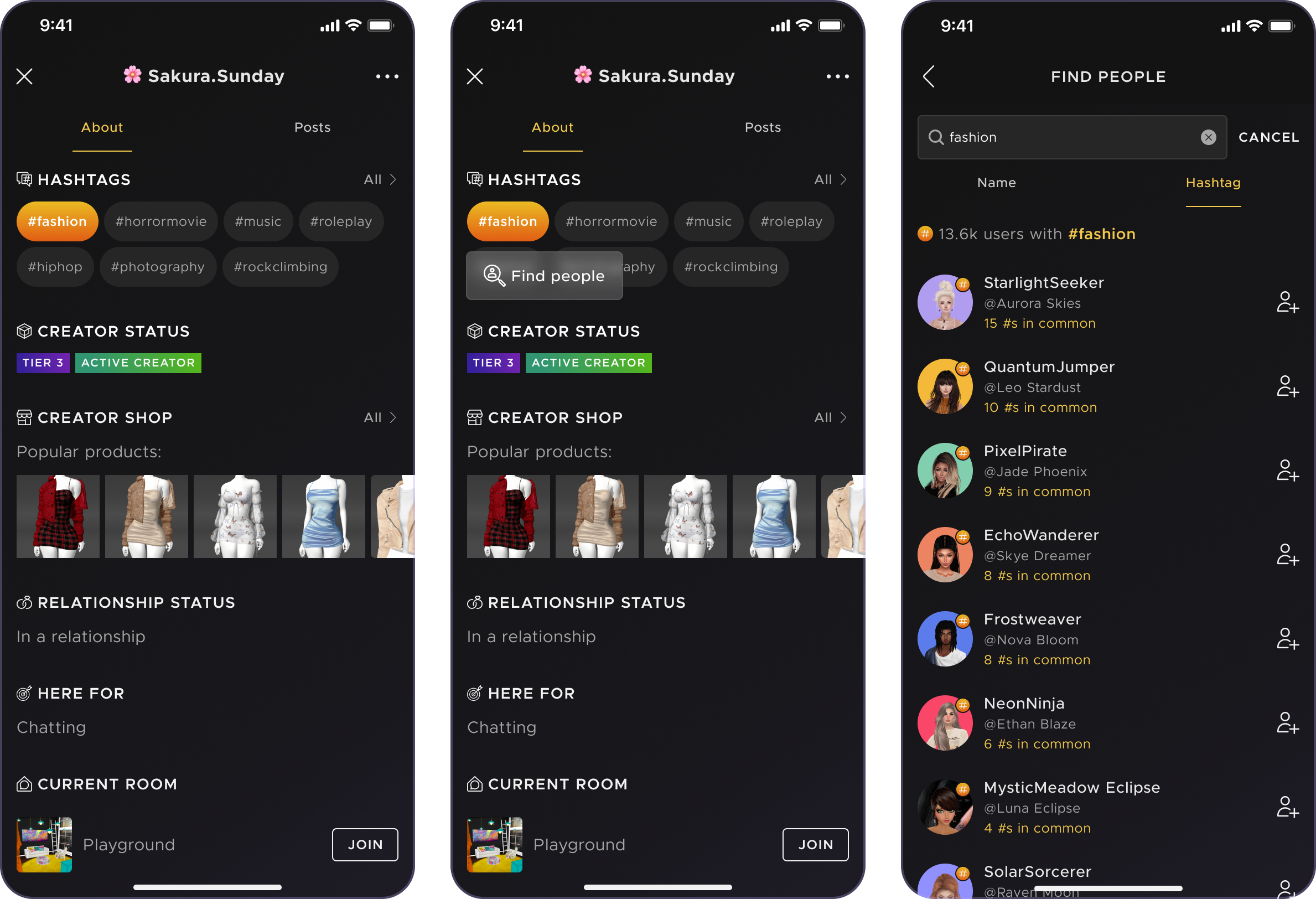
People Discovery via Hashtags
Any hashtag chip becomes an entry point to discover new connections: long-press/right-click opens “Find People,” launching interest-based results where users can browse profiles and connect beyond name search.
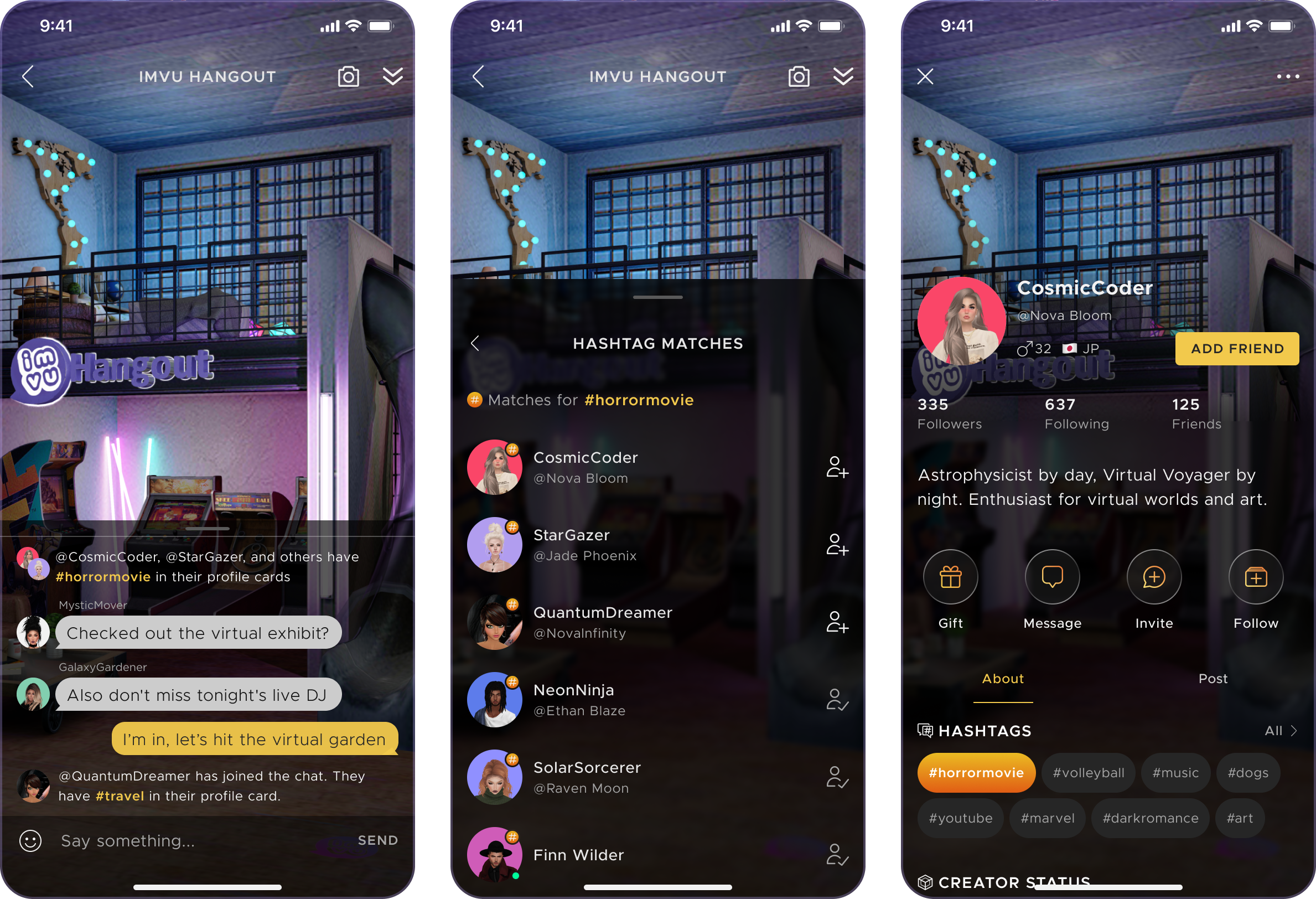
Chat Icebreakers
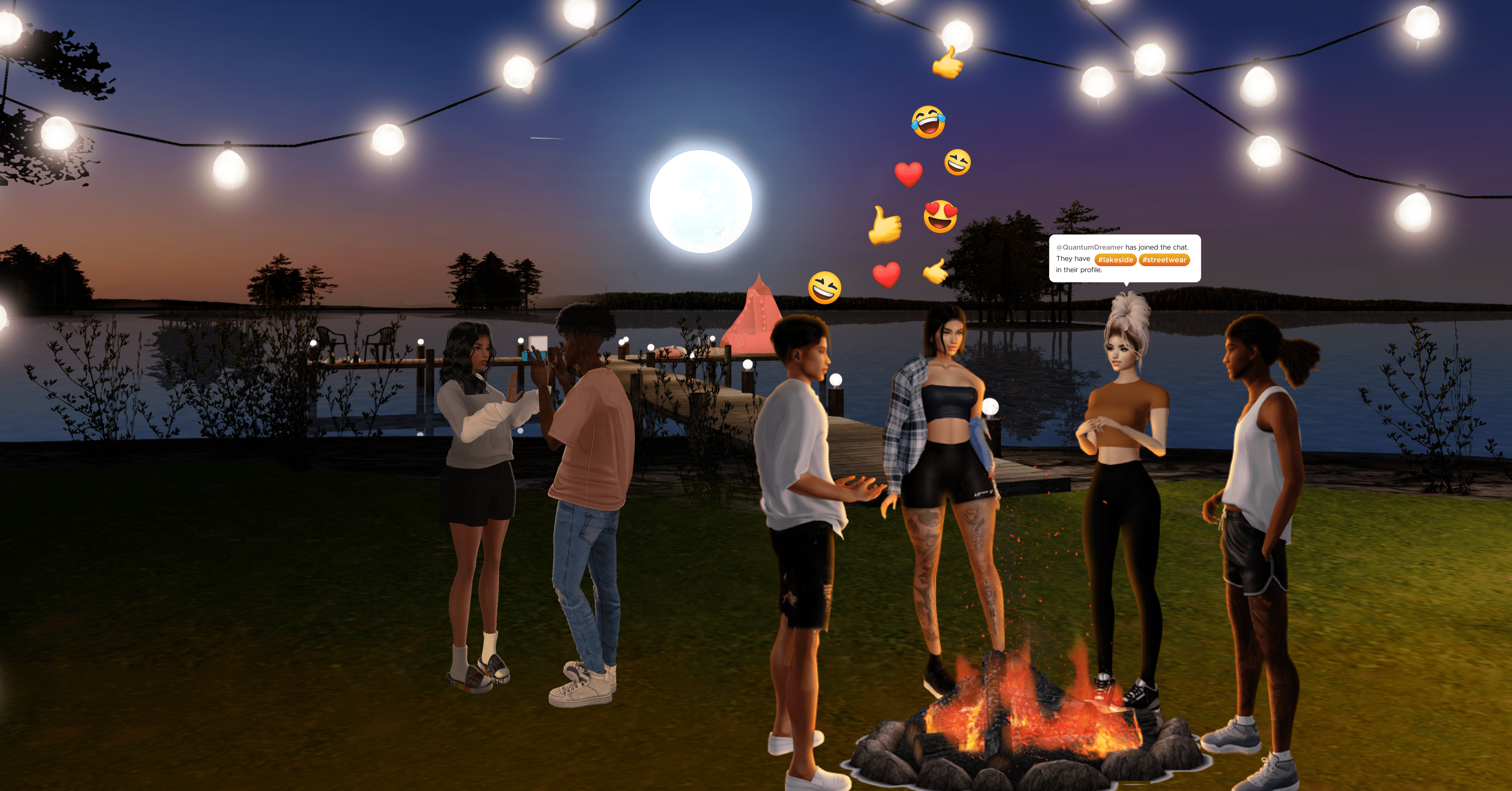
Inside group chat, I surface private prompts that highlight people with overlapping hashtags—both in-room and when someone new joins—making it easier to start conversations and convert presence into meaningful connections.
Phase 2: Room Hashtags
Phase 2 is Room Hashtags—extending the same interest graph from people into places. It helps users jump into rooms with like-minded people faster—and once inside, shared-hashtag cues make it easy to spot “people like me” in group chat and connect or send friend requests right from the conversation.
Hashtags on Room Card
We launched a personalized “For You” rooms swimlane powered by profile hashtags. Each room card shows up to three room hashtags (set by people in the room) so users can quickly read the vibe and join spaces that match their interests.
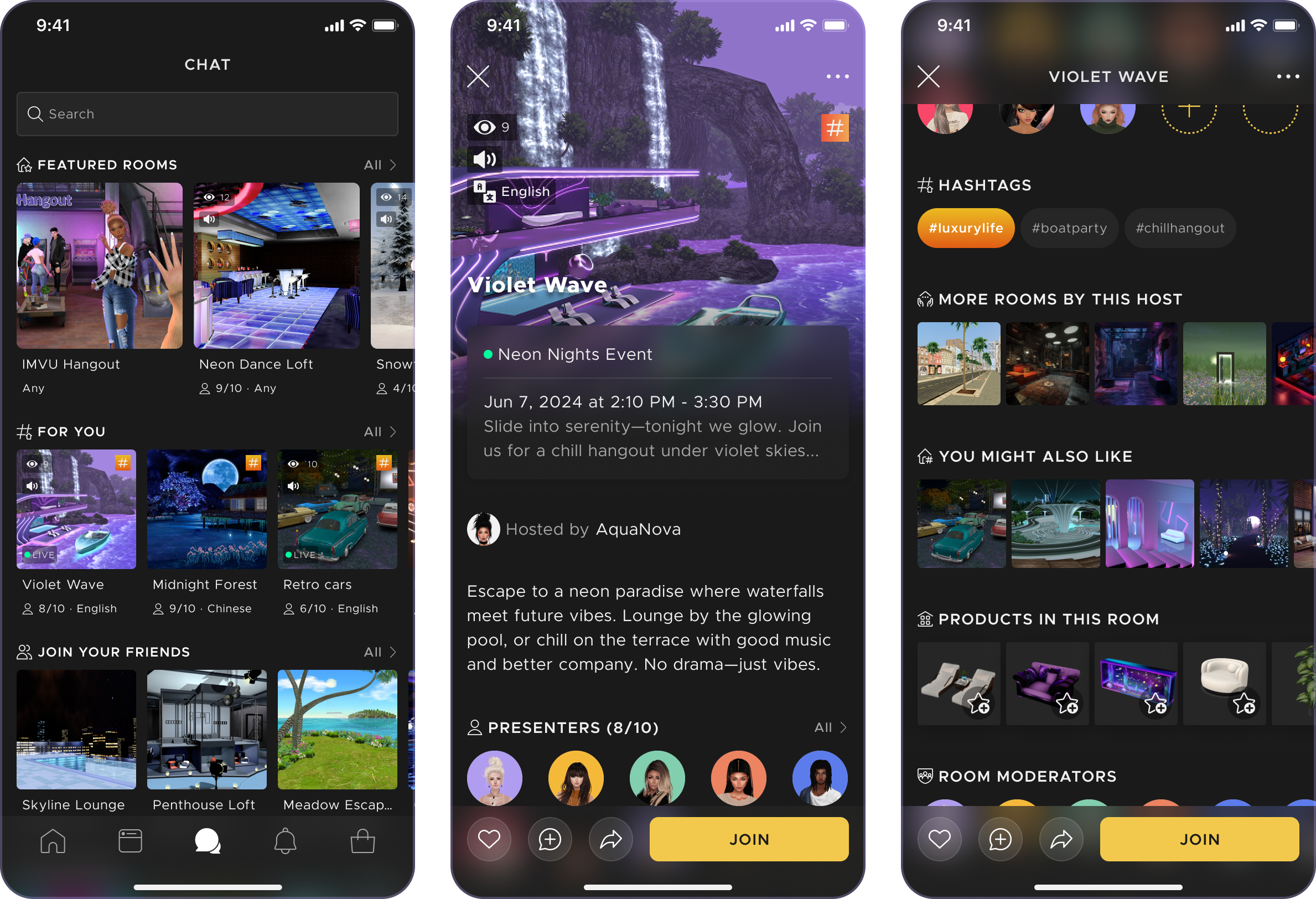

Quickly Find Rooms via Hashtag
Room hashtags are interactive discovery controls: users can add/remove the tag, mark “Not interested” to tune recommendations, or jump to similar rooms—so every tap improves personalization and speeds up finding relevant conversations.
Room Search
Via Filters
I redesigned room search into an intent-driven filter flow with quick-edit pills and an “All Filters” panel. This makes searching more predictable and gets users from intent → join faster.

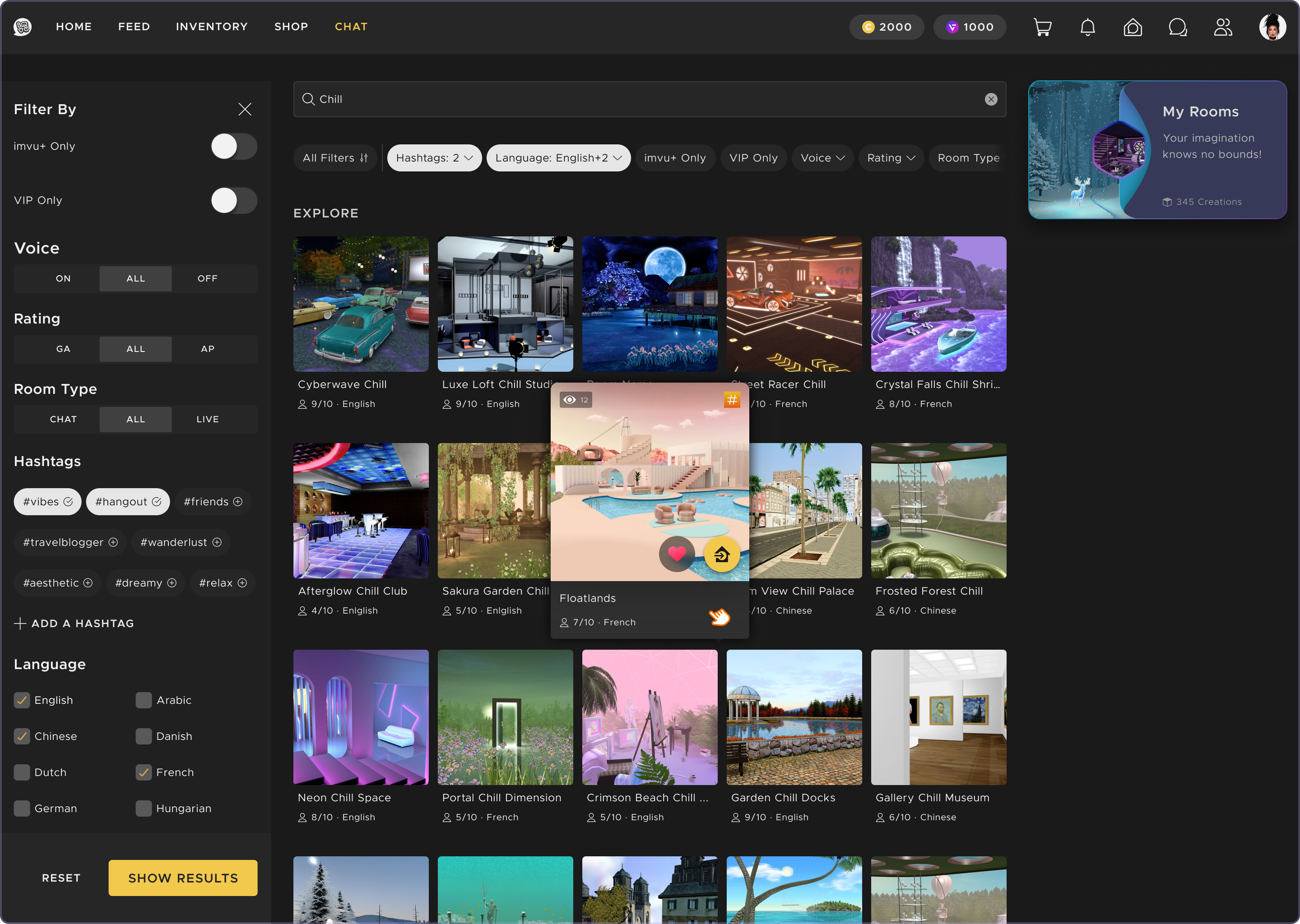
Web Design
This project extends to web with desktop-native patterns: a collapsible left filter rail and hashtag pills under the search bar for fast, high-density refinement. I also use hover to keep the default UI clean while revealing key details and quick actions (Join, Like) directly on the tile—so users can act without opening the room card.
Phase 1 Impact
Six months after we released People Hashtags on all platforms, the feature has been widely adopted.
This is especially exciting because the goal of People Hashtags is to reach sufficient adoption to serve as a foundation for other features.
Adoption
50%
of mobile MAU have hashtags on profile
1.5M
unique users have hashtags on their profiles
Discovery
1.6×
follow/add from # people search
8.3
average hashtags per active profile (enough depth for matching)
Engagement
17%
of mobile DAU use hashtag search
2 days
between tag updates
Retention
+0.6 pp
Overall D7 retention delta (seasonality-adjusted)
+1.5 pp
among users with at least one shared-hashtag conversation (evidence of early-week stickiness)
What's Next
Now that Phase 1 (People Hashtags) is implemented and Phase 2 (Room Hashtags) is in progress, the next steps are about turning this shared-interest layer into stronger, repeatable connection outcomes.
People Hashtag
Room Hashtag
Friend Matcher
Personalization
Build an interest identity layer on profiles
Extend the same interest language into places
Move from “search and browse” to proactive matching
Turn hashtags into ongoing discovery journeys across feed and shop
In Their Words
Hashtags made IMVU feel less random and more findable—people say it’s easier to spot shared interests, discover the right rooms, and meet the right folks. Profiles read cleaner and the experience feels more purposeful, not just endless scrolling.


Reflections
An Interest Graph You Can Feel
Hashtags, for me, weren’t just UI chips—they were a way to design for belonging. In a social world as big as IMVU, the hardest moment is “where do I start, and who will I click with?” I wanted to turn that vague, lonely feeling into something specific: these are my people and these are my rooms. That’s why I designed hashtags as connective tissue, not a one-off feature.
And once that language exists, it doesn’t stop at profiles: it becomes the backbone for what’s next—stronger friend matches, and smarter recommendations across the shop and feed, all grounded in the same shared-interest graph.
Unified Library, First Flight
Hashtags shipped as the first feature on our new cross-platform design library, so my work went beyond the feature itself. I mapped every pattern we touched—chips, cards, filters, search, empty states—into real components, helped tune them for accessibility and motion, and worked with engineering to plug each library drop into production without surprises. The payoff: fewer one-off UI hacks, faster builds, and a cleaner, more consistent product everywhere.



© 2026 Yuming Zheng · Made with 🍵